Field Notes · No. 01
How to Organize Your Child's End-of-Year Artwork
(Without throwing the memories away.)
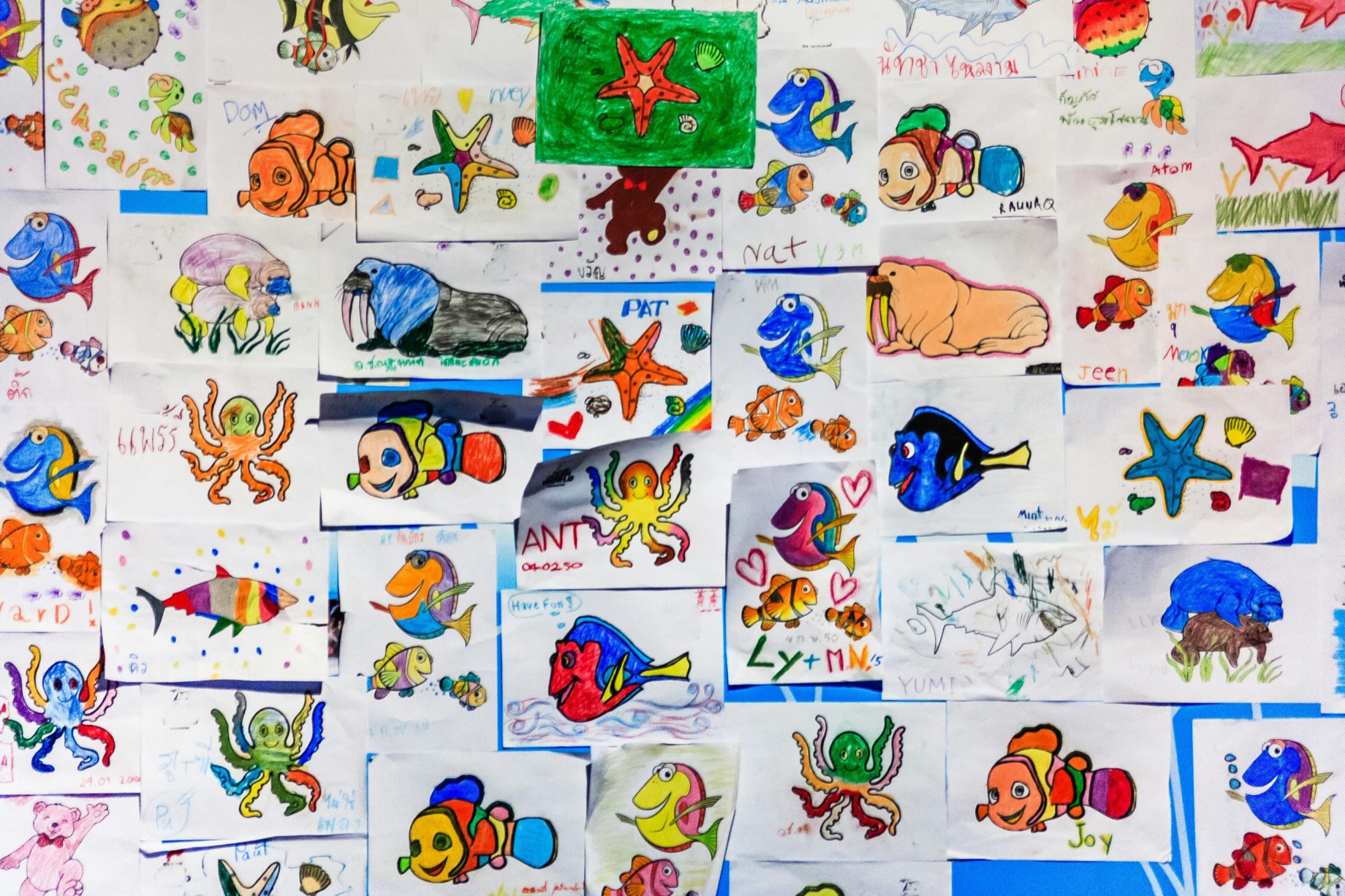
It happens every June.
Your kid walks in on the last day of school dragging a grocery bag bulging with paintings, half-finished worksheets, a wobbly clay pinch pot, and what appears to be a self-portrait drawn entirely in glitter glue.
You hug them. You praise the dragon. You set the bag on the kitchen counter, intending to "deal with it this weekend."
Three weeks later, the bag is still there. Two more bags have joined it.
If you've felt that specific blend of love, guilt, and quiet panic — you are not alone, and you are not failing. End-of-year artwork is one of the hardest small problems in modern parenting, because it sits at the exact intersection of three feelings that don't get along:
- Love. Your child made these. You can see their growth in every line.
- Reality. You live in an apartment. Or a house. Either way, you do not live in the Whitney.
- Guilt. Throwing any of it away feels like throwing a piece of them away.
This post is the system I wish someone had handed me on the morning of my first end-of-year backpack dump. It's the system I now use every June for my own two kids — and it's the system that, eventually, led me to build the app I'll mention near the end. But the system works even if you never download anything. That's the point.
The Reframe: Keep the Meaning, Not the Paper
Here is the single sentence that changed how I think about kids' artwork:
The artwork is not the memory. The artwork is the receipt for the memory.
Your child's drawing of a purple cat is meaningful because of who they were the week they made it — the way they pronounced "purple" as "puhpuh," the friend they made it for, the lunchbox argument that came right before. The paper is just the receipt that all of that happened.
When you internalize this, the math changes. You don't need to keep every receipt. You need to make sure the memory is preserved somewhere — and that somewhere can be far more compact than a box in a closet you never open.
The rest of this post is a practical 4-step triage that lets you keep the meaning while letting most of the paper go.
The 4-Step End-of-Year Artwork Triage
You can do this in one evening per child. Pour something. Put on music your kid likes. This is supposed to feel ceremonial, not bureaucratic.
Sort with your child — 10 minutes
This is the most important step, and the one parents are most tempted to skip "to save time." Don't skip it.
Dump the entire pile on the floor. Sit on the floor with your kid. Ask them three questions, in this exact order:
- "Which one are you most proud of?" (lets them pick first)
- "Which one is a story?" (the macaroni rocket they made for grandma's birthday — that's a story)
- "Which ones are okay to let go?" (this is the radical question — they will surprise you)
Kids, especially under 8, are far less attached to most of their output than we assume. They made it, they enjoyed making it, they are done with it. The grief you're carrying about "letting it go" is usually yours, not theirs.
Make three piles: keep, photograph and release, release.
Pick the museum pieces — 3 to 5 per kid
From the "keep" pile, pick a strict number. I use 5 per kid per school year. Some people use 3. Some people use 10. The number doesn't matter — having a number does.
These are the pieces that earn physical existence. They go in a flat archival box (acid-free, gusseted, labeled by year and child's name). Or they get framed. Or they get scanned later and made into a year-end photo book.
Everything else from the "keep" pile moves to "photograph and release."
This step will feel painful in the first year. By the third year, you will thank yourself, because the museum pieces actually become findable and re-encounterable. A 5-piece archive is a treasure. A 200-piece archive is a storage unit.
Photograph the rest in a single session
Now the bulk of the pile. The trick here is batching.
Most parents try to photograph kids' artwork one piece at a time, in the moment, on a chaotic kitchen counter, with bad light. The photos end up dark, tilted, with a juice box in the corner. You hate them. You delete them. The artwork goes in the recycling un-photographed, and you feel terrible.
Instead, set up a one-time mini studio. It takes 90 seconds:
- A piece of plain white poster board on the floor near a window
- Phone held parallel to the artwork (use the gridlines)
- Natural light, no flash
- Tap once to focus on the center of the page
Photograph the whole "photograph and release" pile in a single session, one after another. Five seconds per piece. A stack of 40 drawings takes under five minutes.
Capture the story — don't skip this
This is the step that separates a forgotten camera-roll folder from a real archive your kid will actually want to look at when they're 15.
For each museum piece, and for any photographed piece your kid had something to say about — record one voice memo with your kid talking about it. Twenty to forty seconds is plenty. Prompts that work:
- "Tell me about this one. What's happening in the picture?"
- "Who's in it?"
- "What's the best part?"
- "Why did you choose those colors?"
Then write down — or have your phone transcribe — the date, the child's age, and the school grade.
I cannot overstate this: in five years, the voice recording will be more valuable than the artwork itself. A 4-year-old's voice explaining their dragon, with their specific 4-year-old vocabulary and the specific way they pronounce words they haven't quite mastered — that recording is unrepeatable. Their drawing technique will improve. Their voice at this age happens once.
This is the step almost everyone skips. It's also the step that, ten years from now, you will be glad you didn't.
Why a Photo Album Alone Won't Cut It in Five Years
If you do all four steps and dump the results into your iPhone's camera roll, you have a problem in slow motion.
Two years from now, you'll have 600 artwork photos mixed in with screenshots of recipes and pictures of your friend's dog. You won't be able to find them by child, by year, or by story. The voice memos will be in a separate app. The date will be embedded in metadata you can't easily browse.
You haven't lost the memories. You've just put them in a place where they will never be visited again.
This is the part of the problem I personally got stuck on for years before I started building anything. Capturing is the easy part. Curating, organizing, and re-encountering is where every system I tried fell apart.
A few solutions, in order of effort:
- Lowest effort. A shared iCloud album per child, named by year. ("Mira 2025–2026 Art.") Drop everything in. The voice memos won't live here, but at least the photos are sorted.
- Medium effort. A year-end photo book, made through Chatbooks or Artkive's scanning service. You pay; they make a book. The book lives on a shelf and gets re-encountered, which is the magic.
- Higher effort, much higher payoff. A dedicated archive that holds the artwork, the voice memo, the child's age, and the date in one place — organized by child and chronologically browsable.
That last option is what I ended up building.
A Note About TinyAtelier
I'm a parent and an iOS developer. I have two kids. I built TinyAtelier because every June for years, I did Steps 1–3 of the system above, and I never quite figured out Step 4 — the voice, the context, the re-encounter.
I tried photo apps. They were great for photos and terrible for stories. I tried note-taking apps. They were great for stories and terrible for photos. I tried physical scrapbooks. I made it through exactly one year before life happened.
TinyAtelier is opinionated software for one specific job: preserving kids' artwork as a small private museum, with the child's voice and context built in. A few things that make it different:
- It treats artwork like a museum, not a camera roll. Each piece gets a wall-label-style page: photo, your child's voice telling the story, their age, the date. You browse by child, by year, by exhibition.
- The AI helps you curate, but it never writes for your child. TinyAtelier uses AI to write a short, neutral, museum-style description of each piece. But the personal voice on every page is your child's own audio recording. AI only selects. AI never speaks. That principle is the soul of the app.
- It works offline. It stays on your device. Your child's voice and your family's archive don't get used to train anything. Your data is yours.
- It's built for the parent who tried five other systems and quit. Setup is two minutes. The first artwork takes about 30 seconds.
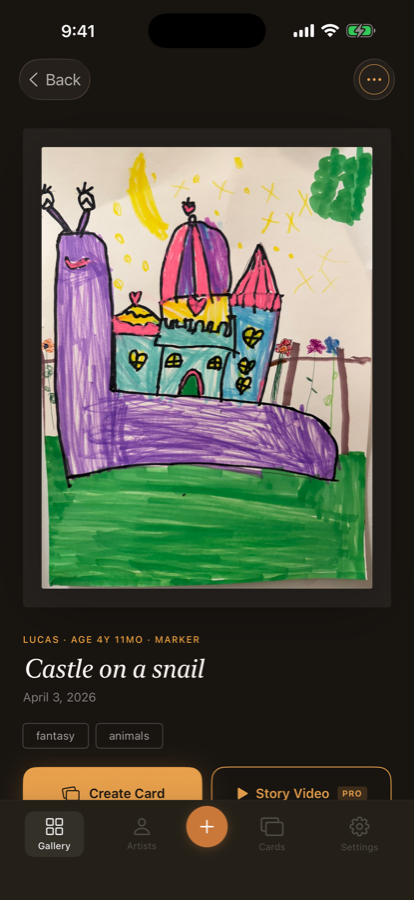
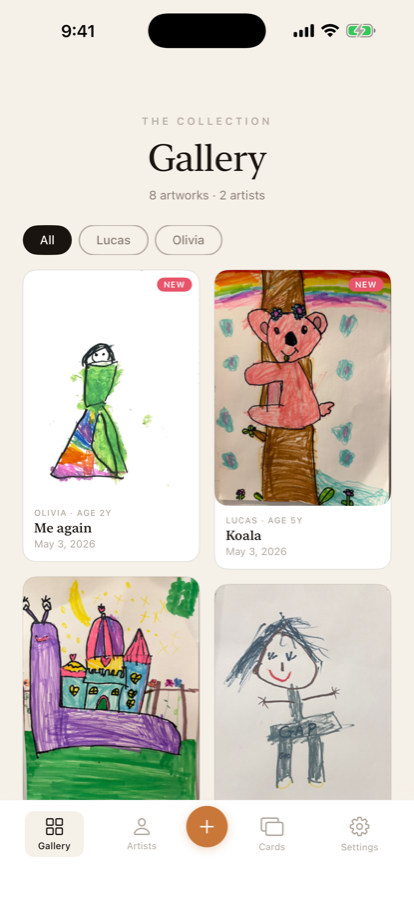
If the system in this post sounds right but you know yourself well enough to know you'll never actually maintain it in a folder — TinyAtelier is the version of this system that travels with you, in your pocket, every June.
One Last Thing
A few months ago, my older kid did something I haven't been able to stop thinking about.
They finished a drawing — a rainbow with a small house and a very large sun — and instead of asking me to put it on the fridge, they handed it to me and said:
Somewhere along the way, in a household where I had been quietly photographing their work for a year, they had learned that a thing doesn't have to be kept to be remembered. They had absorbed, without anyone teaching them, that the photograph carried the memory, and the paper could move on.
That's the small revolution I'm hoping to be part of. Not a war on paper. Not minimalist parenting. Just a slightly more honest relationship between what we love about our kids' work and what we actually need to store.
The drawing is not the memory. The drawing is the receipt for the memory.
This June, you don't have to keep every receipt.